
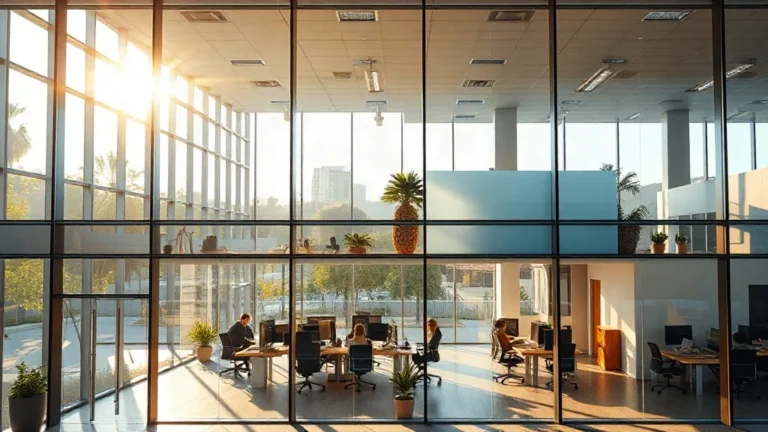
Tint City Inc, headquartered in Rancho Cucamonga, California, has installed commercial window tinting for Inland Empire property owners, retailers, and office managers since 1991. In that time, the most consistent call we receive from commercial clients is about energy — specifically, why cooling bills stay stubbornly high even after HVAC equipment upgrades. The answer is usually the glass. Untreated windows allow solar heat to enter a building before your air conditioning system ever has a chance to respond. Window film addresses that problem at the source, and the financial impact shows up on the next utility billing cycle.
Need expert guidance on the right commercial window film specification for your building?
Contact Tint City Inc at (800) 468-7244 for a no-obligation commercial consultation.

Why Inland Empire Buildings Lose Significant Energy Through Glass
Commercial buildings in Southern California lose a measurable share of their cooling capacity directly through untreated glass — 3M estimates that solar heat gain through windows accounts for approximately 33% of a commercial building’s cooling expenses. The Inland Empire compounds this problem. Summer temperatures in Rancho Cucamonga, Corona, and Loma Linda regularly push HVAC systems toward their design limits, and west-facing glass in particular becomes a sustained heat source from early afternoon through early evening. That sustained load forces cooling equipment into longer cycles, drives up peak demand charges on commercial utility accounts, and creates the uneven hot zones that generate tenant complaints.
Property managers often respond with blinds, interior shading systems, or thermostat adjustments — but those approaches shift heat distribution rather than removing solar energy from the building envelope. Commercial window film intercepts that energy at the glass surface before it enters the occupied space at all.

How Solar Heat Gain Control Works with Commercial Window Film
Commercial window film works by intercepting solar energy at the glass surface before it converts to interior heat, reducing solar heat gain without replacing existing windows, disrupting building operations, or altering the exterior appearance of a property. Solar Gard flat-glass films, which Tint City Inc installs as a certified Solar Gard SELECT SHOP, use advanced multi-layer construction to reflect and absorb infrared radiation while maintaining clear views and natural daylight. The films are applied to the interior surface of existing glass — a process that typically does not require tenants to vacate or business operations to pause.
Tint City also installs Solar Gard daylight redirecting film, which pushes up to 80% of incoming light deeper into a building’s interior. In offices where perimeter desks are bright but interior workstations stay underlit, this reduces lighting electricity use while improving visual comfort across the entire floor plate — a benefit particularly relevant for the large-footprint commercial buildings common along the Haven Avenue Corridor and Foothill Boulevard in Rancho Cucamonga.
Real ROI: Energy Savings and Tenant Comfort for Inland Empire Properties
Properly installed commercial window tinting can reduce a building’s cooling costs by 10 to 30 percent, depending on glass exposure, building orientation, and local climate — with Inland Empire properties typically performing toward the higher end of that range given summer heat intensity. After more than three decades of handling commercial film installs across San Bernardino, Riverside, and Los Angeles Counties, the pattern that comes up most often is property managers who have already replaced HVAC units but still can’t normalize tenant comfort on west-facing floors. The glass is still the source of the load. Window film is the faster, less disruptive intervention — installation happens in days, not months, and requires no structural changes to the building envelope.
For multi-tenant buildings, stable indoor temperatures carry their own financial value beyond the utility line. Tenants who are comfortable renew leases. Tenants who are not, escalate complaints and eventually leave. Tint City’s commercial window tinting service starts with a free estimate so every film specification is matched to the building’s actual glass type, cardinal orientation, and energy priorities — not a default product applied to every job. See how we approach this work in specific Inland Empire markets: commercial window film installation in Corona, CA and commercial window film installation in Rancho Cucamonga.

Why Inland Empire Businesses Choose Tint City Inc for Commercial Window Film
Tint City Inc has operated as a Solar Gard SELECT SHOP serving Rancho Cucamonga, Corona, Loma Linda, and San Dimas since 1991 — a family-run business with four physical Inland Empire locations and more than 1,000 combined Yelp reviews across those shops. SELECT SHOP designation is not a standard dealer agreement. It is Solar Gard’s recognition for installers who have met specific standards for product knowledge, installation quality, and brand representation, and it gives Tint City’s team direct access to Solar Gard’s full commercial flat-glass lineup: solar control films, Low-E films, safety and security films, anti-graffiti film, and daylight redirecting film.
Commercial inquiries at all four Tint City locations route through a single dedicated line — (800) 468-7244 — so property managers responsible for multiple sites are not bounced between branches. Every commercial project begins with a consultation and free estimate, because the right film specification for a south-facing medical office suite in Loma Linda is not the same as the right film for a north-facing retail storefront in San Dimas. Those differences matter for performance and for ROI.
Frequently Asked Questions About Commercial Window Tinting and Energy Savings
What types of commercial buildings benefit most from window tinting?
Buildings with large glass facades, west- or south-facing exposures, and open floor plans benefit most from commercial window tinting. Retail storefronts, medical offices, multi-tenant office buildings, and facilities with skylights or curtain-wall glass are the most common candidates. In the Inland Empire, where afternoon sun angles are intense through summer, any building with unshaded glass on its western or southern face will see measurable cooling cost reductions and tenant comfort improvements after commercial window film is installed. A free estimate from Tint City will identify which glass surfaces carry the highest energy load.
How long does commercial window film installation take?
Most commercial window film installations are completed room-by-room or floor-by-floor from the building’s interior, causing minimal disruption to ongoing operations. A single-story retail suite or small office can typically be completed within a day; a multi-floor commercial building is generally phased across several days. Tint City Inc coordinates with facility managers to schedule work around tenant hours and building operations at each of its four Inland Empire locations — Rancho Cucamonga, Corona, Loma Linda, and San Dimas — so work proceeds without requiring tenant relocation.
Does commercial window tinting block UV rays that fade merchandise and interior finishes?
Yes. Solar Gard commercial window films block more than 99% of UVA and UVB rays, which are the primary driver of fading in flooring, upholstery, merchandise displays, and interior finishes. For retailers, medical offices, and showrooms with valuable inventory or interior contents, UV protection is often as important as heat rejection and energy savings when selecting a commercial film specification. Fading is cumulative and irreversible; intercepting UV rays at the glass surface is the most effective protection available without replacing the glass itself.
Ready to lower your building’s energy costs with professional commercial window film?
Contact Tint City Inc at (800) 468-7244 for a free commercial estimate at any of our four Inland Empire locations.